This class defines common system clock interfaces. More...
#include <system_clock.hpp>
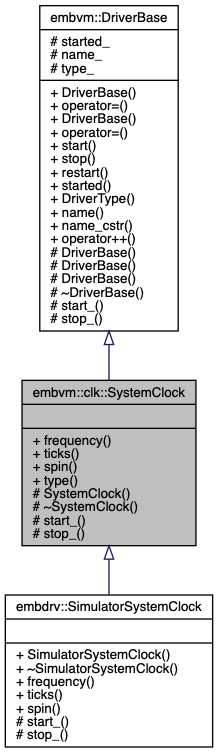
Public Types | |
| using | spin_duration_t = std::chrono::duration< uint32_t, std::micro > |
| Default spin increment is microseconds. More... | |
| using | tick_duration_t = std::chrono::duration< uint64_t, std::micro > |
Public Member Functions | |
| virtual freq_hz_t::rep | frequency () const noexcept=0 |
| Get the frequency of the system clock. More... | |
| virtual tick_duration_t::rep | ticks () const noexcept=0 |
| Check the ticks elapsed since boot. More... | |
| virtual void | spin (spin_duration_t::rep count) noexcept=0 |
| Spin the processor for the specified number of ticks. More... | |
| void | start () noexcept |
| Start the driver. More... | |
| void | stop () noexcept |
| Stop the driver. More... | |
| void | restart () noexcept |
| Restart the driver. More... | |
| type_safe::boolean | started () const noexcept |
| Check if the driver has been started. More... | |
| constexpr embvm::DriverType_t | DriverType () const noexcept |
| Returns the registered type ID of the driver. More... | |
| constexpr const std::string_view & | name () const noexcept |
| Provides a string_view reference of the driver name. More... | |
| constexpr const char * | name_cstr () const noexcept |
| Provides a c-string version of the driver name. More... | |
| virtual DriverBase & | operator++ () noexcept |
| Increment operator is a no-op, but is used for iterator compatibility. More... | |
Static Public Member Functions | |
| static constexpr embvm::DriverType | type () noexcept |
| SystemClock Driver Type ID. More... | |
Protected Member Functions | |
| SystemClock () noexcept | |
| Default constructor. More... | |
| ~SystemClock () noexcept | |
| Default destructor. More... | |
| void | start_ () noexcept override=0 |
| Derived classes override the start_ method to control driver-specific startup behavior. More... | |
| void | stop_ () noexcept override=0 |
| Derived classes override the start_ method to control driver-specific startup behavior. More... | |
Protected Attributes | |
| type_safe::boolean | started_ = false |
| Tracks the driver state. More... | |
| const std::string_view | name_ |
| Name of the driver instance. More... | |
| const embvm::DriverType_t | type_ |
| Type ID of the driver instance. More... | |
Detailed Description
This class defines common system clock interfaces.
Define a system clock driver
To create a system clock driver, derive from the SystemClock object:
Derived classes must implement the following interfaces:
- frequency()
- tips()
- spin()
Derived classes must also implement pure virtual embvm::DriverBase functions:
Member Typedef Documentation
◆ spin_duration_t
| using embvm::clk::SystemClock::spin_duration_t = std::chrono::duration<uint32_t, std::micro> |
Default spin increment is microseconds.
◆ tick_duration_t
| using embvm::clk::SystemClock::tick_duration_t = std::chrono::duration<uint64_t, std::micro> |
Constructor & Destructor Documentation
◆ SystemClock()
|
inlineprotectednoexcept |
Default constructor.
Initializes the SystemClock instance with a generic name.
◆ ~SystemClock()
|
protecteddefaultnoexcept |
Default destructor.
Member Function Documentation
◆ DriverType()
|
inlinenoexceptinherited |
Returns the registered type ID of the driver.
When using DriverBase interfaces, clients can retrieve the registered driver type in order to up-cast to the correct interface.
The type is returned as a embvm::DriverType_t rather than a embvm::DriverType enum to work with custom user-defined types. Enforcing a embvm::DriverType return value would prevent clients from defining and using their own custom types.
- Returns
- the registered driver type as a embvm::DriverType_t value
References embvm::DriverBase::type_.
◆ frequency()
|
pure virtualnoexcept |
Get the frequency of the system clock.
- Returns
- the frequency of the system clock, in Hz.
Implemented in embdrv::SimulatorSystemClock.
◆ name()
|
inlinenoexceptinherited |
Provides a string_view reference of the driver name.
- Returns
std::string_viewref containing the driver name.
References embvm::DriverBase::name_.
◆ name_cstr()
|
inlinenoexceptinherited |
Provides a c-string version of the driver name.
- Returns
- c-string containing the driver name
References embvm::DriverBase::name_.
◆ operator++()
|
inlinevirtualnoexceptinherited |
Increment operator is a no-op, but is used for iterator compatibility.
◆ restart()
|
inlinenoexceptinherited |
Restart the driver.
Calls stop() and then start() on the driver. If the driver is not started, then it will be started after the start() function is invoked.
References embvm::DriverBase::start(), and embvm::DriverBase::stop().
◆ spin()
|
pure virtualnoexcept |
Spin the processor for the specified number of ticks.
Derived classes must implement the spin() function.
- Parameters
-
count The number of ticks to spin the processor for.
Implemented in embdrv::SimulatorSystemClock.
◆ start()
|
inlinenoexceptinherited |
Start the driver.
If the driver is not started, call the start_() function defined by the derived class. (Template Method Pattern)
References embvm::DriverBase::start_(), and embvm::DriverBase::started_.
Referenced by NRF52DongleHWPlatform::init_(), NRF52DKHWPlatform::init_(), BlinkySimulatorHWPlatform::init_(), FWDemoSimulatorHWPlatform::init_(), FrameworkDemoSimPlatform::initHWPlatform_(), embvm::DriverBase::restart(), embvm::timer::Timer::restart(), embvm::spi::activeMaster< TQueueSize, TLock, TCond >::start_(), embvm::i2c::activeMaster< 128 >::start_(), embdrv::aardvarkSPIMaster::start_(), embdrv::aardvarkI2CMaster::start_(), embdrv::aardvarkGPIOInput< 4 >::start_(), embdrv::vl53l1x::start_(), embdrv::aardvarkGPIOOutput< 5 >::start_(), BlinkySimulatorHWPlatform::startBlink(), and FWDemoSimulatorHWPlatform::startLEDTimer().
◆ start_()
|
overrideprotectedpure virtualnoexcept |
Derived classes override the start_ method to control driver-specific startup behavior.
(Template Method Pattern)
Implements embvm::DriverBase.
Implemented in embdrv::SimulatorSystemClock.
◆ started()
|
inlinenoexceptinherited |
Check if the driver has been started.
- Returns
trueif the driver is running (started),falseif not running (stopped).
References embvm::DriverBase::started_.
Referenced by embdrv::aardvarkSPIMaster::configure_(), embdrv::aardvarkGPIOInput< 4 >::get(), embdrv::aardvarkGPIOOutput< 5 >::set(), embdrv::vl53l1x::start_(), embdrv::aardvarkAdapter::start_(), and embdrv::aardvarkAdapter::stop_().
◆ stop()
|
inlinenoexceptinherited |
Stop the driver.
If the driver has been started, call the stop_() function defined by the derived class. (Template Method Pattern)
References embvm::DriverBase::started_, and embvm::DriverBase::stop_().
Referenced by embvm::DriverBase::restart(), embvm::timer::Timer::restart(), embvm::spi::activeMaster< TQueueSize, TLock, TCond >::stop_(), embvm::i2c::activeMaster< 128 >::stop_(), embdrv::aardvarkSPIMaster::stop_(), embdrv::aardvarkI2CMaster::stop_(), embdrv::aardvarkGPIOInput< 4 >::stop_(), embdrv::aardvarkGPIOOutput< 5 >::stop_(), FWDemoSimulatorHWPlatform::~FWDemoSimulatorHWPlatform(), and embdrv::SimulatorTimer::~SimulatorTimer().
◆ stop_()
|
overrideprotectedpure virtualnoexcept |
Derived classes override the start_ method to control driver-specific startup behavior.
(Template Method Pattern)
Implements embvm::DriverBase.
Implemented in embdrv::SimulatorSystemClock.
◆ ticks()
|
pure virtualnoexcept |
Check the ticks elapsed since boot.
Derived classes must implement the ticks() function.
- Returns
- ticks elapsed since boot.
Implemented in embdrv::SimulatorSystemClock.
Referenced by embvm::LoggerBase< TLock >::log().
◆ type()
|
inlinestaticnoexcept |
Member Data Documentation
◆ name_
|
protectedinherited |
Name of the driver instance.
Referenced by embvm::DriverBase::name(), and embvm::DriverBase::name_cstr().
◆ started_
|
protectedinherited |
Tracks the driver state.
True if the driver has been started, false if it has been stopped or not yet started.
Referenced by embvm::DriverBase::start(), embvm::DriverBase::started(), and embvm::DriverBase::stop().
◆ type_
|
protectedinherited |
Type ID of the driver instance.
Referenced by embvm::DriverBase::DriverType().
The documentation for this class was generated from the following files:
- src/core/driver/system_clock.hpp
- src/core/driver/internal/system_clock.cpp