Embedded Framework utility classes and functions. More...
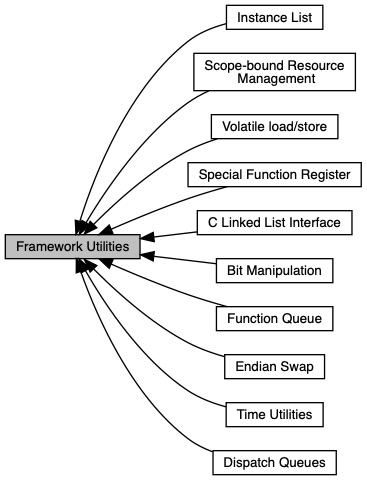
|
Modules | |
| Special Function Register | |
| Safer types for working with special-function registers. | |
| Bit Manipulation | |
| Functions and macros that operate in a bitwise manner. | |
| Dispatch Queues | |
| Group of worker threads that enables asynchronous processing. | |
| Endian Swap | |
| Functions that can be used to swap the endianness of a value. | |
| Function Queue | |
| Queues for storing function objects. | |
| Instance List | |
| Supports tracking instances which can come and go during runtime. | |
| C Linked List Interface | |
| A linked list library for C modules. | |
| Scope-bound Resource Management | |
| Utilties that enable SBRM techniques. | |
| Time Utilities | |
| Functions that work with C and C++ time types. | |
| Volatile load/store | |
| These functions promote safer loading and storing of volatile values. | |
Classes | |
| class | embutil::InterruptLock< InterruptLockPolicy > |
| BasicLockable class which disables/enables interrupts. More... | |
Functions | |
| template<class TClass , class Method , Method m, class... Params> | |
| static auto | embutil::bounce (void *priv, Params... params) noexcept -> decltype(((*reinterpret_cast< TClass * >(priv)).*m)(params...)) |
| Enable a C++ member function to work with a C-style callback interface. More... | |
Detailed Description
Embedded Framework utility classes and functions.
Class Documentation
◆ embutil::InterruptLock
| class embutil::InterruptLock |
template<typename InterruptLockPolicy>
class embutil::InterruptLock< InterruptLockPolicy >
BasicLockable class which disables/enables interrupts.
This class defines a BasicLockable interface for enabling and disabling interrupts. The lock() function is used to disable interrupts, and unlock() to enable them.
- Note
- This lock is not re-entrant.
Public Member Functions | |
| InterruptLock ()=default | |
| Default constructor. More... | |
| ~InterruptLock ()=default | |
| Default destructor. More... | |
| InterruptLock (const InterruptLock &)=delete | |
| Deleted copy constructor. More... | |
| const InterruptLock & | operator= (const InterruptLock &)=delete |
| Deleted copy assignment operator. More... | |
| InterruptLock (InterruptLock &&)=default | |
| Deleted move constructor. More... | |
| InterruptLock & | operator= (InterruptLock &&)=default |
| Deleted move assignment operator. More... | |
| void | lock () noexcept |
| void | unlock () noexcept |
| Enable interrupts to leave critical section. More... | |
Private Attributes | |
| InterruptLockPolicy::TReturn | irq_status_ |
| Local storage for the disable function result, which is passed into the enable function to ensure we restore the prior value. More... | |
Constructor & Destructor Documentation
◆ InterruptLock() [1/3]
|
default |
Default constructor.
◆ ~InterruptLock()
|
default |
Default destructor.
◆ InterruptLock() [2/3]
|
delete |
Deleted copy constructor.
◆ InterruptLock() [3/3]
|
default |
Deleted move constructor.
Member Function Documentation
◆ lock()
|
inlinenoexcept |
◆ operator=() [1/2]
|
delete |
Deleted copy assignment operator.
◆ operator=() [2/2]
|
default |
Deleted move assignment operator.
◆ unlock()
|
inlinenoexcept |
Enable interrupts to leave critical section.
This function is marked noexcept because we want the program to terminate if an exception results from this call.
References embutil::InterruptLock< InterruptLockPolicy >::irq_status_.
Member Data Documentation
◆ irq_status_
|
private |
Local storage for the disable function result, which is passed into the enable function to ensure we restore the prior value.
Referenced by embutil::InterruptLock< InterruptLockPolicy >::lock(), and embutil::InterruptLock< InterruptLockPolicy >::unlock().
Function Documentation
◆ bounce()
|
staticnoexcept |
Enable a C++ member function to work with a C-style callback interface.
This function is intended to be passed to a C-style callback system which takes a function pointer and private data pointer as input values. Using C-style callbacks is problematic with object member functions, as you need the object's pointer to get to the correct instance.
This bounce function requires use of the private data pointer in a C-style callback. The data pointer must be used for the object's instance pointer. Any other provided arguments are forwarded to the object's member function, and the return value is passed to the caller.
You can simplify this call with the BOUNCE() macro.
You may need to reinterpret_cast the bounce function to the expected type:
You will need to couple a bounce function with the this pointer as a function input to get to the correct instance.
Example usage with a C-style callback interface
posixThread is a C++ class, and posixThread::thread_func() is a member function which we want to pass to pthread_create(). The this pointer is captured and passed into the private input data argument, which is forwarded to the thread.
The use case above is too verbose, so we recommend the BOUNCE() macro instead:
This function is marked noexcept because we want the program to terminate if an exception results from this call. We can't guarantee the bounce function won't throw.
- Template Parameters
-
TClass The type of class with the member function to be used as a callback. Method The type of the member function to use as a callback. m The function pointer corresponding to the class's member function. Params Variadic template list of function parameters to forward to the member function.
- Parameters
-
priv The private data pointer, which must always be passed the class's thispointer so bounce can resolve to the correct instance.params Variadic list of parameters to forward to the member function.
- Returns
- the value returned by the member function.