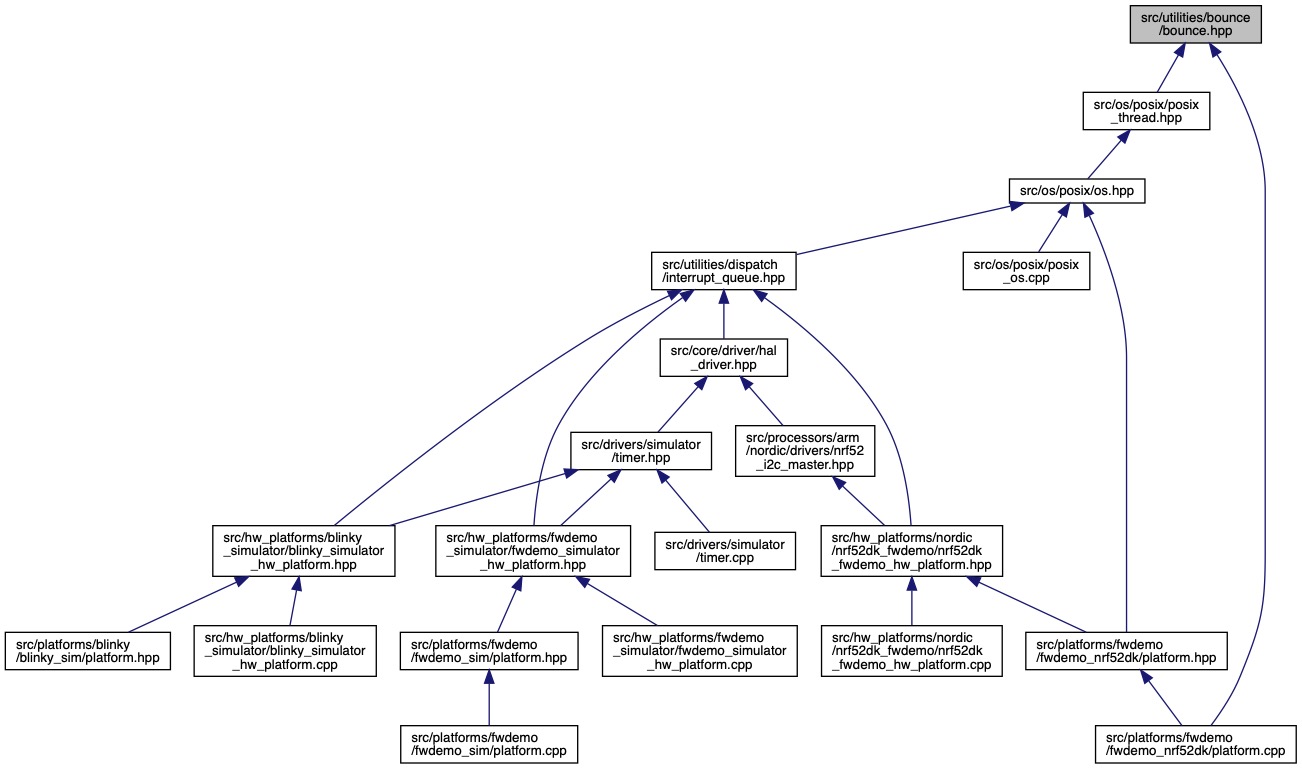
This graph shows which files directly or indirectly include this file:
Namespaces | |
| embutil | |
| Embedded framework utility functions and classes. | |
Macros | |
| #define | BOUNCE(c, m) embutil::bounce<c, decltype(&c::m), &c::m> |
| Convenience macro to simplify bounce statement usage. More... | |
Functions | |
| template<class TClass , class Method , Method m, class... Params> | |
| static auto | embutil::bounce (void *priv, Params... params) noexcept -> decltype(((*reinterpret_cast< TClass * >(priv)).*m)(params...)) |
| Enable a C++ member function to work with a C-style callback interface. More... | |
Macro Definition Documentation
◆ BOUNCE
| #define BOUNCE | ( | c, | |
| m | |||
| ) | embutil::bounce<c, decltype(&c::m), &c::m> |
Convenience macro to simplify bounce statement usage.
The BOUNCE() macro simplifies the creation of a bounce function to a class member for use with C-style callbacks. The BOUNCE() macro must be paried with a this pointer to get to the proper class instance.
Example usage with a C-style callback interface.
posixThread is a C++ class, and posixThread::thread_func() is a member function which we want to pass to pthread_create().
// Our interfaces demand a void(*)(void*), so we adapt to posix's requirement
// and simply skip out on the return to the caller's perspective
r = pthread_create(&handle_, &attributes,
reinterpret_cast<void*>(this));
- Parameters
-
c The class type. m The member function in the class
- Returns
- A bounce function which redirects a C-style callback to a class member function.