Macros | |
| #define | _CTYPE_A 0x00000100L /* Alpha */ |
| #define | _CTYPE_C 0x00000200L /* Control */ |
| #define | _CTYPE_D 0x00000400L /* Digit */ |
| #define | _CTYPE_G 0x00000800L /* Graph */ |
| #define | _CTYPE_L 0x00001000L /* Lower */ |
| #define | _CTYPE_P 0x00002000L /* Punct */ |
| #define | _CTYPE_S 0x00004000L /* Space */ |
| #define | _CTYPE_U 0x00008000L /* Upper */ |
| #define | _CTYPE_X 0x00010000L /* X digit */ |
| #define | _CTYPE_B 0x00020000L /* Blank */ |
| #define | _CTYPE_R 0x00040000L /* Print */ |
| #define | _CTYPE_I 0x00080000L /* Ideogram */ |
| #define | _CTYPE_T 0x00100000L /* Special */ |
| #define | _CTYPE_Q 0x00200000L /* Phonogram */ |
| #define | _CTYPE_SW0 0x20000000L /* 0 width character */ |
| #define | _CTYPE_SW1 0x40000000L /* 1 width character */ |
| #define | _CTYPE_SW2 0x80000000L /* 2 width character */ |
| #define | _CTYPE_SW3 0xc0000000L /* 3 width character */ |
| #define | _CTYPE_SWM 0xe0000000L /* Mask for screen width data */ |
| #define | _CTYPE_SWS 30 /* Bits to shift to get width */ |
Functions | |
| int | isalnum (int ch) |
| Checks if the given character is an alphanumeric character. More... | |
| int | isalpha (int ch) |
| Checks if the given character is an alphabetic character. More... | |
| int | isascii (int ch) |
| Checks if a given character is a 7-bit US-ASCII character. More... | |
| int | isblank (int ch) |
| Checks if the given character is a blank character. More... | |
| int | iscntrl (int ch) |
| Checks if the given character is a control character. More... | |
| int | isdigit (int ch) |
| Checks if the given character is a numeric character. More... | |
| int | isgraph (int ch) |
| Checks if the given character has a graphical representation. More... | |
| int | islower (int ch) |
| Checks if the given character is classified as a lowercase character. More... | |
| int | isprint (int ch) |
| Checks if the given character can be printed. More... | |
| int | ispunct (int ch) |
| Checks if the given character is a punctuation character. More... | |
| int | isspace (int ch) |
| Checks if the given character is a whitespace character. More... | |
| int | isupper (int ch) |
| Checks if the given character is an uppercase character. More... | |
| int | isxdigit (int ch) |
| Checks if the given character is a hexadecimal numeric character. More... | |
| int | tolower (int ch) |
| Converts the given character to lowercase. More... | |
| int | toupper (int ch) |
| Converts the given character to lowercase. More... | |
| int | toascii (int ch) |
| Converts the given character to ASCII. More... | |
Macro Definition Documentation
◆ _CTYPE_A
| #define _CTYPE_A 0x00000100L /* Alpha */ |
◆ _CTYPE_B
| #define _CTYPE_B 0x00020000L /* Blank */ |
◆ _CTYPE_C
| #define _CTYPE_C 0x00000200L /* Control */ |
◆ _CTYPE_D
| #define _CTYPE_D 0x00000400L /* Digit */ |
◆ _CTYPE_G
| #define _CTYPE_G 0x00000800L /* Graph */ |
◆ _CTYPE_I
| #define _CTYPE_I 0x00080000L /* Ideogram */ |
◆ _CTYPE_L
| #define _CTYPE_L 0x00001000L /* Lower */ |
◆ _CTYPE_P
| #define _CTYPE_P 0x00002000L /* Punct */ |
◆ _CTYPE_Q
| #define _CTYPE_Q 0x00200000L /* Phonogram */ |
◆ _CTYPE_R
| #define _CTYPE_R 0x00040000L /* Print */ |
◆ _CTYPE_S
| #define _CTYPE_S 0x00004000L /* Space */ |
◆ _CTYPE_SW0
| #define _CTYPE_SW0 0x20000000L /* 0 width character */ |
◆ _CTYPE_SW1
| #define _CTYPE_SW1 0x40000000L /* 1 width character */ |
◆ _CTYPE_SW2
| #define _CTYPE_SW2 0x80000000L /* 2 width character */ |
◆ _CTYPE_SW3
| #define _CTYPE_SW3 0xc0000000L /* 3 width character */ |
◆ _CTYPE_SWM
| #define _CTYPE_SWM 0xe0000000L /* Mask for screen width data */ |
◆ _CTYPE_SWS
| #define _CTYPE_SWS 30 /* Bits to shift to get width */ |
◆ _CTYPE_T
| #define _CTYPE_T 0x00100000L /* Special */ |
◆ _CTYPE_U
| #define _CTYPE_U 0x00008000L /* Upper */ |
◆ _CTYPE_X
| #define _CTYPE_X 0x00010000L /* X digit */ |
Function Documentation
◆ isalnum()
| int isalnum | ( | int | ch | ) |
Checks if the given character is an alphanumeric character.
Checks if the given character is an alphanumeric character using the default locale. The following characters are alphanumeric:
- digits (0123456789)
- uppercase letters (ABCDEFGHIJKLMNOPQRSTUVWXYZ)
- lowercase letters (abcdefghijklmnopqrstuvwxyz)
The behavior is undefined if the value of ch is not representable as unsigned char and is not equal to EOF.
- Parameters
-
ch The character to classify
- Returns
- Non-zero value if the character is an alphanumeric character, 0 otherwise.
References isalpha(), and isdigit().
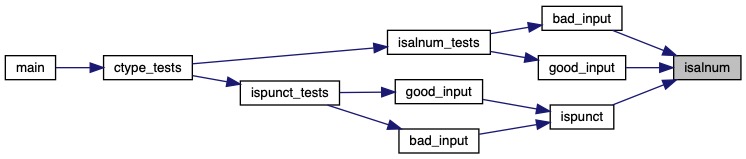
Referenced by bad_input(), good_input(), and ispunct().
◆ isalpha()
| int isalpha | ( | int | ch | ) |
Checks if the given character is an alphabetic character.
Checks if the given character is an alphabetic character, i.e. either an uppercase letter (ABCDEFGHIJKLMNOPQRSTUVWXYZ), or a lowercase letter (abcdefghijklmnopqrstuvwxyz)
The behavior is undefined if the value of ch is not representable as unsigned char and is not equal to EOF.
- Parameters
-
ch The character to classify
- Returns
- Non-zero value if the character is an alphabetic character, zero otherwise.
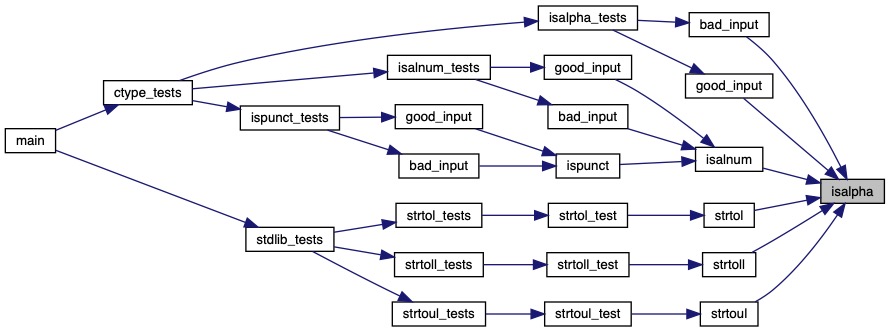
Referenced by bad_input(), good_input(), isalnum(), strtol(), strtoll(), and strtoul().
◆ isascii()
| int isascii | ( | int | ch | ) |
Checks if a given character is a 7-bit US-ASCII character.
Checks if a given character 7-bit unsigned char value that fits into the ASCII character set. which is any character between 0 and 0x7f inclusive.
The behavior is undefined if the value of ch is not representable as unsigned char and is not equal to EOF.
- Parameters
-
ch The character to classify
- Returns
- Non-zero value if ch is a 7-bit US-ASCII character code, zero otherwise.
Referenced by bad_input(), and good_input().

◆ isblank()
| int isblank | ( | int | ch | ) |
Checks if the given character is a blank character.
Checks if the given character is a blank character using the default locale. The following characters classified as blank:
- space (0x20)
- horizontal tab (0x09)
The behavior is undefined if the value of ch is not representable as unsigned char and is not equal to EOF.
- Parameters
-
ch The character to classify
- Returns
- Non-zero value if the character is a blank character, zero otherwise.
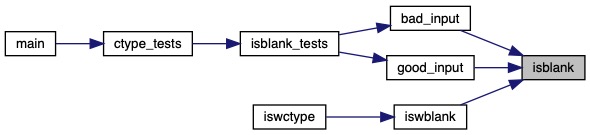
Referenced by bad_input(), good_input(), and iswblank().
◆ iscntrl()
| int iscntrl | ( | int | ch | ) |
Checks if the given character is a control character.
Checks if the given character is a control character. The following are examples of control character:
- codes (0x00-0x1F) and (0x7F)
The behavior is undefined if the value of ch is not representable as unsigned char and is not equal to EOF.
- Parameters
-
ch The character to classify
- Returns
- Non-zero value if the character is a control character, zero otherwise.
Referenced by bad_input(), and good_input().

◆ isdigit()
| int isdigit | ( | int | ch | ) |
Checks if the given character is a numeric character.
Checks if the given character is a numeric character (0123456789).
The behavior is undefined if the value of ch is not representable as unsigned char and is not equal to EOF.
- Parameters
-
ch The character to classify
- Returns
- Non-zero value if the character is a numeric character, zero otherwise.
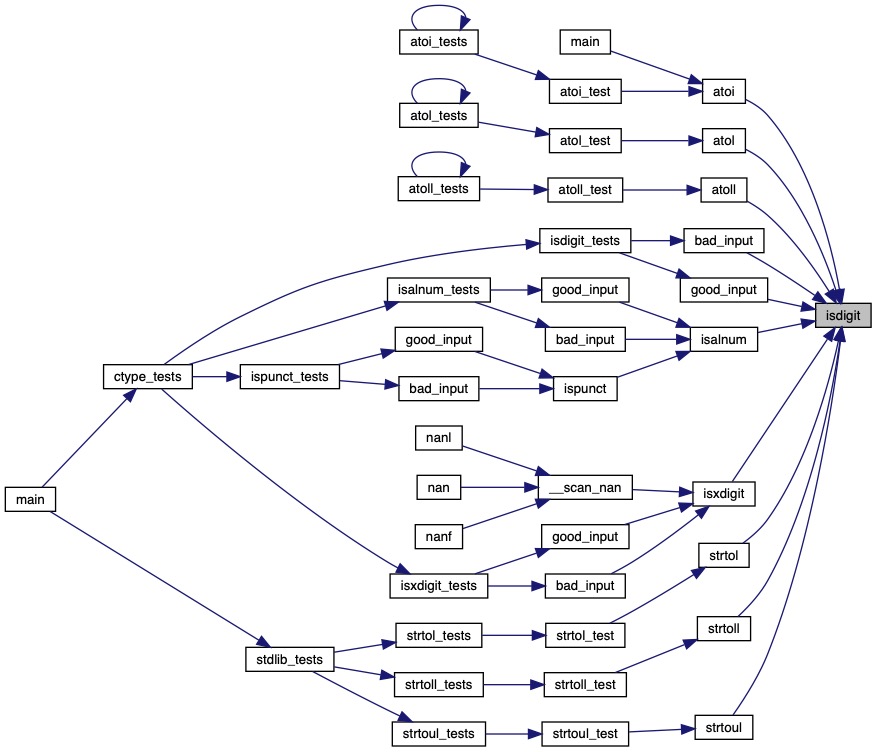
Referenced by atoi(), atol(), atoll(), bad_input(), good_input(), isalnum(), isxdigit(), strtol(), strtoll(), and strtoul().
◆ isgraph()
| int isgraph | ( | int | ch | ) |
Checks if the given character has a graphical representation.
Checks if the given character has a graphical representation using the default locale. The following characters are graphical:
- number (0123456789)
- uppercase letter (ABCDEFGHIJKLMNOPQRSTUVWXYZ)
- letter (abcdefghijklmnopqrstuvwxyz)
- punctuation character (!"#$%&'()*+,-./:;<=>?@[]^_`{|}~)
The behavior is undefined if the value of ch is not representable as unsigned char and is not equal to EOF.
- Parameters
-
ch The character to classify
- Returns
- Non-zero value if the character has a graphical representation character, zero otherwise.
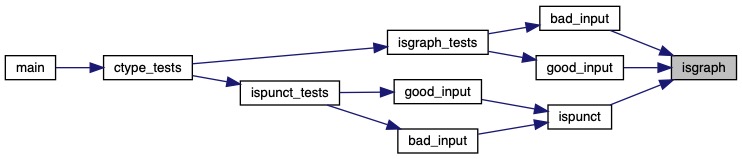
Referenced by bad_input(), good_input(), and ispunct().
◆ islower()
| int islower | ( | int | ch | ) |
Checks if the given character is classified as a lowercase character.
Checks if the given character is classified as a lowercase character using the default local. islower returns true only for the lowercase letters (abcdefghijklmnopqrstuvwxyz). If islower returns true, it is guaranteed that
- See also
- iscntrl,
- isdigit,
- ispunct,
- isspace will return false for the same character in the same default locale.
The behavior is undefined if the value of ch is not representable as unsigned char and is not equal to EOF.
- Parameters
-
ch The character to classify
- Returns
- Non-zero value if the character is a lowercase letter, zero otherwise.
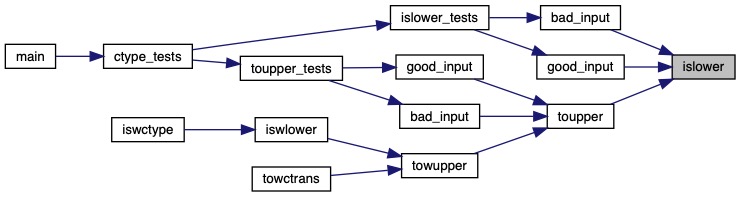
Referenced by bad_input(), good_input(), and toupper().
◆ isprint()
| int isprint | ( | int | ch | ) |
Checks if the given character can be printed.
Checks if the given character can be printed using the default locale. The following characters are printable:
- number (0123456789)
- uppercase letter (ABCDEFGHIJKLMNOPQRSTUVWXYZ)
- letter (abcdefghijklmnopqrstuvwxyz)
- punctuation character (!"#$%&'()*+,-./:;<=>?@[]^_`{|}~)
- space (0x20)
The behavior is undefined if the value of ch is not representable as unsigned char and is not equal to EOF.
- Parameters
-
ch The character to classify
- Returns
- Non-zero value if the character can be printed, zero otherwise.
Referenced by bad_input(), and good_input().

◆ ispunct()
| int ispunct | ( | int | ch | ) |
Checks if the given character is a punctuation character.
Checks if the given character is a punctuation character using the default local. The following characters are classified as punctuation character:
- (!"#$%&'()*+,-./:;<=>?@[]^_`{|}~)
The behavior is undefined if the value of ch is not representable as unsigned char and is not equal to EOF.
- Parameters
-
ch The character to classify
- Returns
- Non-zero value if the character is a punctuation character, zero otherwise.
References isalnum(), and isgraph().
Referenced by bad_input(), and good_input().

◆ isspace()
| int isspace | ( | int | ch | ) |
Checks if the given character is a whitespace character.
Checks if the given character is a whitespace character. The following are examples of a whitespace character:
- space (0x20)
- feed (0x0c)
- line feed (0x0a)
- carriage return (0x0d)
- horizontal tab (0x09)
- vertical tab (0x0b)
The behavior is undefined if the value of ch is not representable as unsigned char and is not equal to EOF.
- Parameters
-
ch The character to classify
- Returns
- Non-zero value if the character is a whitespace character, zero otherwise.
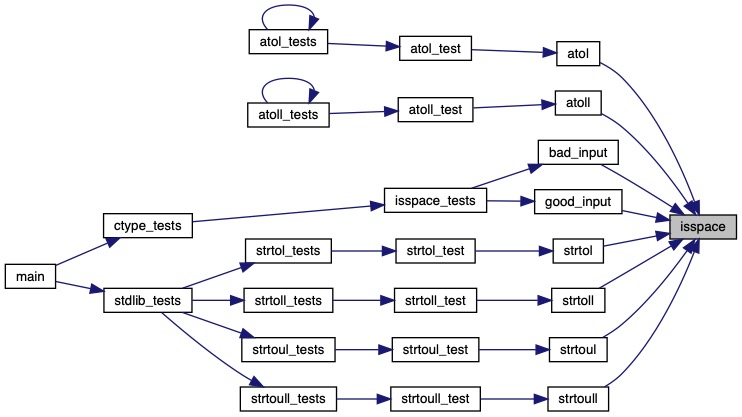
Referenced by atol(), atoll(), bad_input(), good_input(), strtol(), strtoll(), strtoul(), and strtoull().
◆ isupper()
| int isupper | ( | int | ch | ) |
Checks if the given character is an uppercase character.
Checks if the given character is an uppercase character using the default local. isupper returns true only for the uppercase letters (ABCDEFGHIJKLMNOPQRSTUVWXYZ). If isupper returns true, it is guaranteed that
- See also
- iscntrl,
- isdigit,
- ispunct,
- isspace will return false for the same character in the same default locale.
The behavior is undefined if the value of ch is not representable as unsigned char and is not equal to EOF.
- Parameters
-
ch The character to classify
- Returns
- Non-zero value if the character is an uppercase letter, zero otherwise.
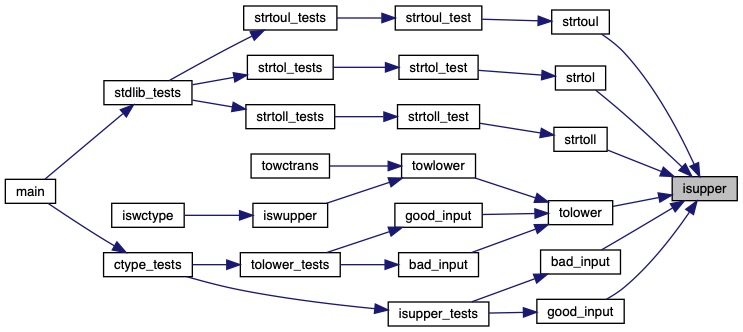
Referenced by bad_input(), good_input(), strtol(), strtoll(), strtoul(), and tolower().
◆ isxdigit()
| int isxdigit | ( | int | ch | ) |
Checks if the given character is a hexadecimal numeric character.
Checks if the given character is a hexadecimal numeric character (0123456789).
The behavior is undefined if the value of ch is not representable as unsigned char and is not equal to EOF.
- Parameters
-
ch The character to classify
- Returns
- Non-zero value if the character is an hexadecimal numeric character, zero otherwise.
References isdigit().
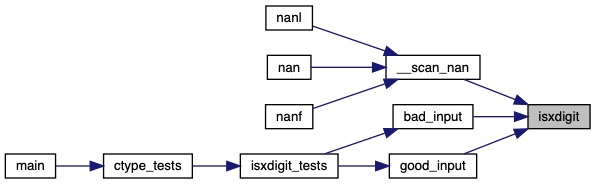
Referenced by __scan_nan(), bad_input(), and good_input().
◆ toascii()
| int toascii | ( | int | ch | ) |
Converts the given character to ASCII.
Converts the given character to a 7-bit unsigned char value that fits into the ASCII character set.
- Parameters
-
ch character to be converted.
- Returns
- The value returned is that of the converted letter, or ch if the conversion was not possible.
Referenced by bad_input(), and good_input().

◆ tolower()
| int tolower | ( | int | ch | ) |
Converts the given character to lowercase.
Converts the given character to lowercase according to the character conversion rules defined by the default local, i.e. the following uppercase letters (ABCDEFGHIJKLMNOPQRSTUVWXYZ) are replaced with respective lowercase letters (abcdefghijklmnopqrstuvwxyz).
The behavior is undefined if the value of ch is not representable as unsigned char and is not equal to EOF.
- Parameters
-
ch character to be converted.
- Returns
- Lowercase version of ch or unmodified ch if no lowercase version is listed in the default locale.
References isupper().
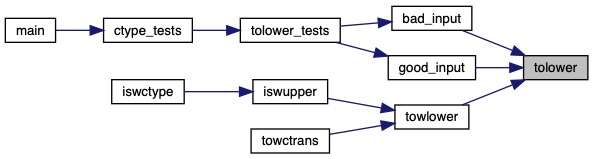
Referenced by bad_input(), good_input(), and towlower().
◆ toupper()
| int toupper | ( | int | ch | ) |
Converts the given character to lowercase.
Converts the given character to lowercase according to the character conversion rules defined by the default local, i.e. the following lowercase letters (abcdefghijklmnopqrstuvwxyz) are replaced with respective uppercase letters (ABCDEFGHIJKLMNOPQRSTUVWXYZ).
The behavior is undefined if the value of ch is not representable as unsigned char and is not equal to EOF.
- Parameters
-
ch character to be converted.
- Returns
- Uppercase version of ch or unmodified ch if no uppercase version is listed in the default locale.
References islower().
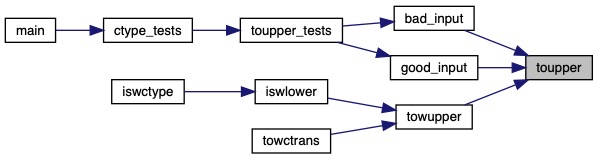
Referenced by bad_input(), good_input(), and towupper().